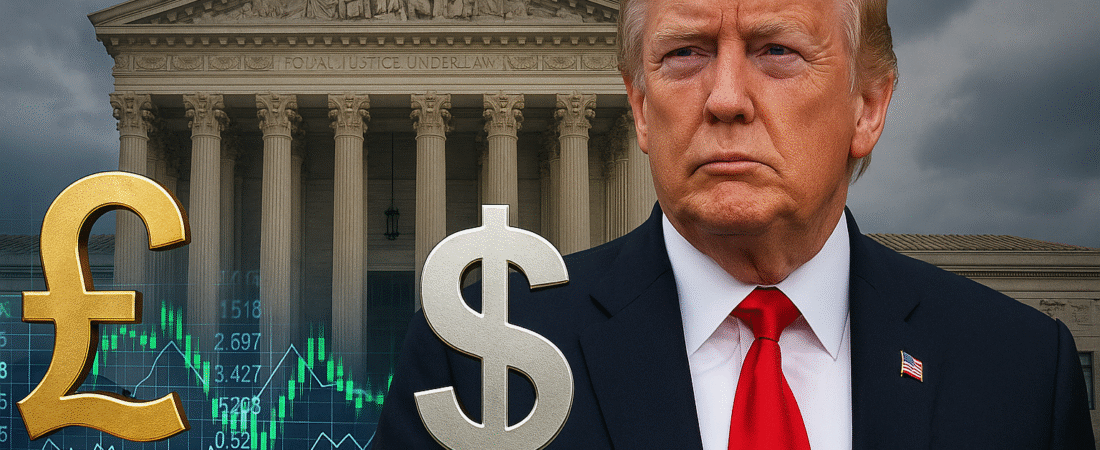
The upcoming US Supreme Court hearing on Donald Trump’s tariff authority is not just a political headline in America. The decision could directly influence UK currency stability, export pricing, investment flows, and global market confidence. When the world’s largest economy shifts trade direction, the UK does not get to sit this one out — especially post-Brexit.
This case is fundamentally about how much power the US president has over tariffs, without needing Congress. And markets hate sudden change.
Why UK Finance Is Exposed
The UK’s trade and financial system is tightly interlinked with the United States:
- The US is one of the UK’s largest export destinations
- British firms rely heavily on US investment capital
- The pound’s stability is influenced by US interest rate and trade policy decisions
If tariffs become a flexible political weapon again, the cost of doing business with the US becomes unpredictable.
For UK businesses, that’s not just inconvenient — it’s strategically dangerous.
The Pound vs the Dollar: Expect Tension
If US tariffs rise, the dollar typically strengthens as investors rush to “safe” American assets.
When the dollar goes up, the pound usually drops.
A weaker pound means:
- UK import costs rise
- UK inflation pressure increases
- The Bank of England faces more rate decision stress
Industries in the UK That Take the Hit First
| Sector | Risk Level | Why It’s Exposed |
|---|---|---|
| Financial Markets & Investment Firms | High | Currency volatility + capital flow shifts |
| Automotive & Machinery Exporters | High | Tariffs hit price competitiveness immediately |
| Scotch Whisky & Heritage Food Brands | Medium | Easy political targets in trade disputes |
| Pharma & Biotech | Medium | Dependent on cross-border approvals & R&D ties |
This isn’t just about trade. It’s about pricing power, value chains, and negotiation leverage.
The Real Issue: The UK Has Limited Bargaining Power
Let’s be blunt:
- The UK is no longer negotiating as part of a trading bloc.
- The US has more leverage.
- If tariffs are used tactically, the UK is one of the easier economies to pressure.
Britain cannot simply “wait and see” — by the time tariffs hit, reaction time is over.
If the Supreme Court Upholds Trump’s Authority
Expect:
- Higher volatility in GBP/USD
- UK exporters adjusting or pausing US planning
- Investors rotating more cash into US markets
- UK inflation pressure returning faster than anticipated
This is how global finance works: one courtroom decision in Washington can move money in London within minutes.
What the UK Should Be Doing Now
But likely won’t — unless pushed:
- Strengthen UK-Japan and UK-India trade ties — these are leverage multipliers.
- Support British exporters with tax relief and energy cost support — real measures, not speeches.
- Shift supply chains closer to Europe — whether politicians like to admit it or not.
- Create financial buffers in high-volatility sectors such as automotive and manufacturing.
The strategy can’t be hope. Hope is not an economic policy.
Conclusion
This Supreme Court case is more than a legal question about tariffs.
It’s a global signal about how power is shifting in trade and finance.
And for the UK — a country currently trying to rebuild its trade identity — this is a direct challenge.
The message is clear:
Stability will not be given. It will have to be built.